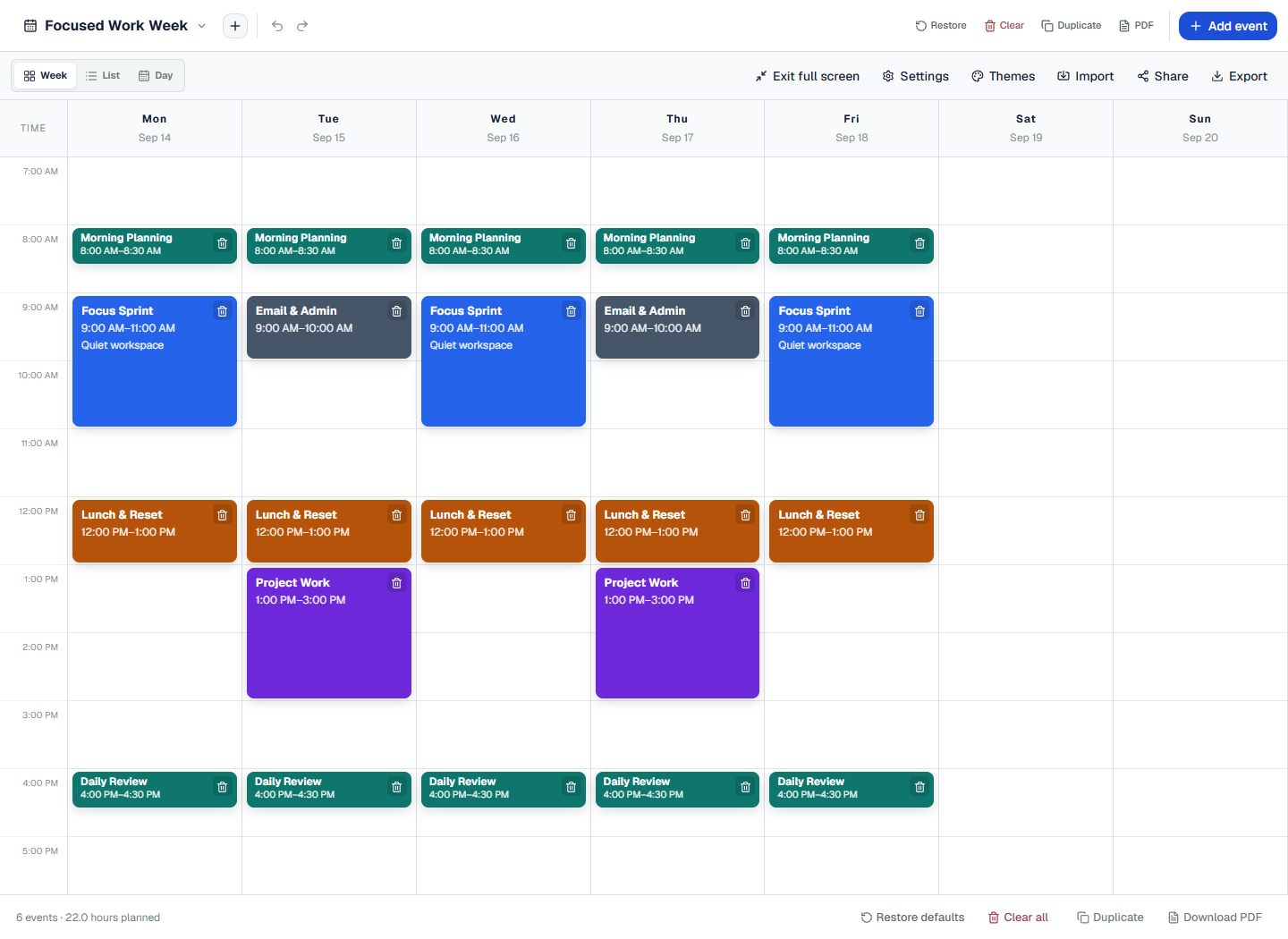

What time blocking means
Time blocking is the practice of reserving a start and end time for a category of work or a specific task. Instead of keeping “prepare presentation” on an open list, you might reserve Tuesday from 9:00 to 10:30 for the outline and Thursday from 10:00 to noon for the slides.
A block is a commitment to work on something, not a promise that the task will be finished. This distinction keeps the calendar useful when work is uncertain.
Begin with a short task inventory
Collect everything competing for your time, then identify which items actually deserve calendar space. Fixed appointments belong on the calendar. Important flexible work needs protected blocks. Very small tasks can be grouped into an administrative block instead of being scheduled one by one.
Use three kinds of blocks
- Fixed blocks: meetings, classes, appointments and deadlines that cannot move.
- Focus blocks: protected time for writing, analysis, study or creative work.
- Flexible blocks: email, errands, follow-up and overflow that can move when the week changes.

Write a finish line for each block
“Work on marketing” is hard to start and impossible to evaluate. “Draft the campaign outline” gives the session a finish line. Put that language in the event title so you know what to do when the block begins.
Match block length to the work
Use 25 to 45 minutes for small tasks or work that feels difficult to begin. Reserve 60 to 90 minutes for deep concentration. Longer blocks can work, but add a planned break and a specific midpoint so the time does not dissolve into one vague session.
Leave room between major blocks and keep part of the week unscheduled. A calendar without buffers turns one delay into an all-day cascade.
Group shallow work
Put email, approvals, forms and routine messages into one or two batches. This reduces the number of times you switch away from focused work. If a message truly cannot wait, it is an exception; it does not need to redesign the entire week.
Plan with a minimum version
For an important habit, decide what counts on a difficult day. A 20-minute review may be the minimum version of a 60-minute study block. A short walk may replace a longer workout. This keeps the schedule resilient instead of making a missed ideal block feel like failure.
Move blocks without abandoning priorities
When the day changes, move the block to a real open space or consciously remove it. Avoid pushing every unfinished task to tomorrow without checking tomorrow’s capacity. If the same block moves repeatedly, it may be too large, poorly timed or less important than you assumed.
A simple time-blocked day
- 8:30–9:00: plan and answer urgent messages
- 9:00–10:30: draft the first section of a report
- 10:30–10:50: break and reset
- 10:50–11:30: administrative batch
- 1:00–2:00: meetings
- 2:15–3:15: analysis and follow-up
- 3:15 onward: flexible capacity and tomorrow’s preparation